Skip to content


X-COM: DOSbox

PC tech has come a long way since UFO: Enemy Unknown (a.k.a. X-COM: UFO Defense) was released in 1994. The game manual has references to ancient technologies consigned to the dusty storerooms of history: AdLib and Roland soundcards; XMS/EMS memory management; SMARTDrive memory cache; DR DOS, Novell DOS and OS/2 operating systems.

The tech the game was originally designed for may be gone and forgotten but running UFO: Enemy Defense is actually easier today than it was back then. Thanks to the brilliant emulator, DOSbox, you can get the game from Steam and immediately begin playing it. There’s no need to hire scientists, construct a laboratory, spend time and money investigating how it’s supposed to work.
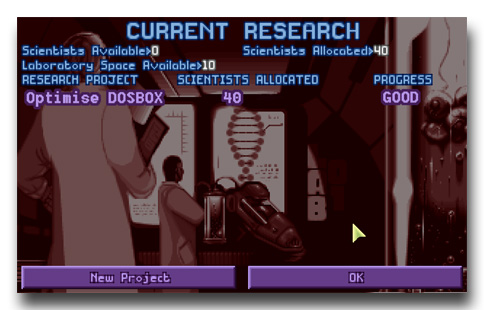
Research

While DOSbox works fine as is, it can be tweaked to taste. To do that, you need to edit the dosbox.conf file in the Steam/steamapps/common/xcom ufo defense subdirectory. I made the following changes:

fullscreen=false
windowresolution=1280×960
scaler=hq3x
cycles=20000

Those changes make the game run in a 1280×960 window, improve the scaling quality and speed up the gameplay slightly. At the very least, I’d recommend changing the cycles setting since DOSBox’s default setting makes the game play a little sluggishly.

In addition to that, this Steam thread has tips for improving the audio. Even with those improvements, expect the game to sound quaint and old timey.

The gameplay, however, is as brilliant as it was 16 years ago. The hardware may change, the software may differ but one suspects X-COM will retain its fundamental appeal 16 years hence.

Posted in Games, X-COM.


X marks the spot

Yes!

I have no idea how. I have no idea why. All I know is when I clicked on the Steam store page for the X-Com Collection a few minutes ago, I was finally — finally! — able to purchase the game. I had been pining to replay UFO: Enemy Unknown for well over a year but Steam never did let me purchase it.

Today something changed. I don’t know why. I don’t really care.

I have X-Com.

(Bonus: the entire collection is on sale for a measly two dollars.)

Let the defense of planet Earth begin.

Posted in Games.


Football Manager 2010: error code 83

Just a quick note for those playing the Steam version of Football Manager 2010. A recent Steam update has apparently caused a minor issue with the game. To wit, you may see the following Steam error message when you attempt to launch it:

Football Manager 2010: error code 83

Translation: “You can’t play. Neener neener.”

Here’s how you may be able to solve it.
Continued…

Posted in Games.


Football Manager 2010: My God, it’s full of stats

Football Manager 2010: Player Stats

Football Manager 2010‘s greatest achievement is it enables series veterans to easily manage the information overload typical of the series; its biggest flaw is it doesn’t do enough for the novice.

The manager is constantly overwhelmed with stats and options in this series. Selecting the first team and substitutes from a squad of 40-plus players for the first time is traditionally a time-consuming affair since picking the best player for a single position is a complicated task. There are 36 major player attributes to take into consideration, each with ratings between 1 and 20, and player roles may require at least competence in several interrelated attributes.

The new manager might be flummoxed gauging something as simple as a player’s speed. Where to start? There is the Pace attribute, of course. Ah, but it’s not that simple because the Acceleration stat must also be taken into account. Then there’s Stamina which will determine how he’ll last over the course of 90 minutes. Oh wait, there’s also Agility and Balance, and we can’t forget his Natural Fitness.

Let’s not even go into the fact there are hidden attributes that affect player behaviour and ability.
Continued…

Posted in Games.


Football Manager 2010: talking Torquay

Football Manager 2010: Torquay United

Though I’m a massive Manchester United fan, I’ve never been particularly inclined to play them during a Championship Manager/Football Manager campaign. That would be like playing as Goliath (in full-faced armoured headgear) in battles mostly against hapless Davids. Victory will follow victory but it all feels hollow.

CM/FM is at its very best when it’s about the little guys. It’s about taking a team anchored at the bottom of the league with no pedigree and with players no one’s heard of, beating expectations and leading them to dizzying heights. It’s the allure of infinite possibility.

Years and years ago, I looked at the English league standings and discovered the bottom-most club in the lowest league (then Division 4) was a club known as Torquay United. I knew nothing about Torquay. I didn’t know where it was located, how big it was, how old it was, what its history was yet to my mind, this football club was the quintessential underdog, the no-hopers.

I chose that club when playing CM for the first time. This was the primitive CM2 96/97 edition, which included digitised commentary by Clive Tyldesley. There was no 3D graphics engine to display matches, not even a 2D match display. It was all text and Tyldesley. It didn’t take me long to tire of the digitised commentary but I had it on long enough to learn Torquay wasn’t actually pronounced “Toh-kweh.”

This would be the ultimate challenge, I thought, a true test of managerial skill. Let’s see how far I can take this “Toh-kee,” this little club I knew nothing about, the one with the odds stacked against them. What a campaign it turned out to be, one of my all-time favourites, right up there with Panzer General, Steel Panthers and UFO: Enemy Unknown. It took me five seasons to lead this unfashionable club from Division Three to the Premier League after which the Gulls dominated the upper echelons for seasons to come. This was fantasy football at its most fantastical, of course, but it was so exhilarating an experience I didn’t care one whit about the sheer absurdity of it all.
Continued…

Posted in Games.