Skip to content


The Last Remnant: by the numbers

The Last Remnant‘s developers seem to think they understand perfectly why RPGs are popular and so they’ve accentuated those elements for their game. The problem is they got it so very wrong.

The Last Remnant is a JRPG for those who believe RPGs should be primarily about levelling up, collecting and crafting. This game has those in staggering amounts.

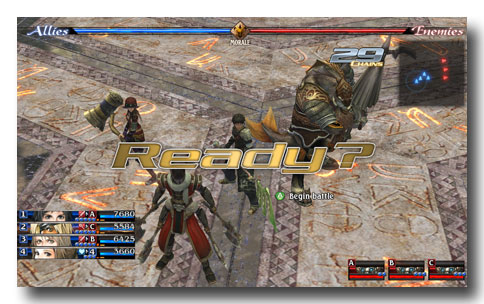
If levelling up one character is satisfying, the developers must have extrapolated levelling up over a dozen characters at a time would be a thrilling experience. Thus, post-battle, the player can expect multiple dings for multiple characters but, like much of the game, these improvements can be indecipherable.

When Emma proclaims her Love has grown after a battle, you can just look bemused. When Torgal switches classes in quick succession, going from Ranger to Swashbuckler to Mystic Knight, you can only shake your head. When Rush somehow manages to change his class to Runemaiden, you can only wonder about his proclivities when he isn’t running around screaming, “Irina!”

The Last Remnant
Continued…

Posted in Games.


The Last Remnant: battle

The Last Remnant

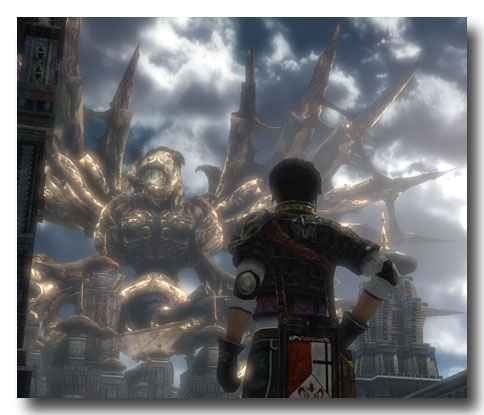
The Last Remnant may not be a Final Fantasy title but it plays like one. Guiding Rush Sykes through the game’s Unreal Engine 3-powered environments is strongly evocative of adventuring with Vaan and company in Final Fantasy XII, and like the 2006 PlayStation 2 game, The Last Remnant provides ample freedom to stray from the main quest to enjoy copious amounts of optional content.

The similarities between the two games aren’t unsurprising given Final Fantasy XII’s popularity outside Japan and Square Enix’s stated intention of making The Last Remnant a cornerstone of its worldwide strategy.

The two games do differ in one aspect and it’s this crucial difference that makes The Last Remnant the lesser game: Final Fantasy XII was designed to streamline battles and minimise tedium whereas The Last Remnant takes the opposite tack.

The Last Remnant’s designers have piled on subsystem after subsystem on what is a simple turn-based battle system and compounded that mistake by withholding information from the player. This is sophistication through obfuscation, complexity through sophistry.
Continued…

Posted in Games.


The Last Remnant

The Last Remnant

Square Enix is one of Japan’s biggest games publishers and it knows it needs to look beyond Japan. The Japanese gaming market, though still formidably large, will eventually succumb to the effects of an aging populace and a birthrate so low only pandas could understand. The resulting decline in consumer population will mean Japan is not the growth market an ambitious game publisher craves, and Square Enix is a very ambitious company indeed. Its flagship Final Fantasy titles are massive, elaborate and bombastic events. These may be costly to produce but when they hit, they hit big.

The Japanese company’s moves in recent years serve to confirm it is shifting its focus away from its domestic market. The collaboration with PopCap for Gyromancer, an odd coming together of PopCap’s casual gameplay and Square Enix’s over-the-top presentation, and the purchase of Eidos both indicate Square Enix sees the writing on the wall. It needs to make games with Western audiences in mind.

A 2008 attempt to translate the Square Enix JRPG formula for the Western market was not a resounding success. The Last Remnant sold 580,000 units across two platforms — a modest and commendable enough number for some but not for a company that thinks big.

There’s little doubt The Last Remnant was made for a Western audience. A Japanese company hoping to hit big with a single-player RPG in its domestic market wouldn’t look at the Xbox 360 and PC platforms. It’s also telling the company chose to go with Unreal Engine 3 for the game rather than use one of its in-house solutions. The company noted Epic’s middleware would reduce development time and costs. What was unsaid was Unreal Engine 3 had been used for major hits by Western publishers.

Unfortunately, quick and cheap usually translates to sloppy, and that was certainly true in The Last Remnant’s case. The Xbox 360 version of the game was rightly criticised for its technical deficiencies and, though improved, the 2009 PC port is not without its issues either.
Continued…

Posted in Games.


Depths of Peril

Depths of Peril

Depths of Peril is unlike any other game out there. This makes its obscurity all the more discouraging. For all the gamer complaints about “Me Too!” game designs, most would still rather bide their time waiting for, say, Diablo III than try something different. Depths of Peril may be no Diablo III but it’s much more interesting than Blizzard’s polished, safe and bland designs.

How best to describe this unusual 2007 game? A single-player Diablo for the MMO generation might be one way. You start with Diablo then tack on MMO-inspired elements like guilds and GvG, and let everything play out in a game world filled with creatures pursuing their own objectives. Somehow all this ambition fits in a game that takes up a mere 100MB of hard disk space.

This is all the more remarkable an achievement since the game was released by an indie developer with only one full-time employee. Soldak Entertainment didn’t have much money to pour into its debut title and it shows. Depths of Peril makes a poor first impression. The game looks middling, the spell effects are sometimes laughable and the animation is often several frames short of smoothness. While it’s certainly not a terrible eyesore, it’s not going to win any best of show awards for presentation.

Depths of Peril may have had a low budget but it’s undeniably rich in gameplay. Interesting ideas, major and minor, abound in this game. While these aren’t always executed flawlessly, the game is rarely uninteresting.
Continued…

Posted in Games, Reviews.


X-COM: two in harmony

X-COM: splash

As history has shown time and time again, when publishers apply pressure on developers, it usually results in lesser games. When a publisher primarily concerned with quarterly financials meddles determinedly in the development process, the game ends up either crippled, released far too early or bloated with unnecessary features incongruously shoehorned in to conform to current trends.

(“A chess game would be okay. But a chess game in HD played with a gimmicky controller, that’s what the world needs right now. Also, can we make it an MMO? And be on Facebook? With DLC?”)

However, UFO: Enemy Unknown a.k.a. X-COM: UFO Defense is an outstanding example of a game that benefitted immensely from publisher meddling.

The story goes Mythos Games’ Julian Gollop had trouble selling the initial Laser Squad-inspired design to Microprose, the game’s eventual publisher. Microprose had hit big with deep strategy games like Railroad Tycoon in 1990 and Civilization in 1991, and requested changes to X-COM’s design to make the game more Microprose-like. This would result in a game that is much greater than the sum of its parts.
Continued…

Posted in Games, Reviews, X-COM.